Hi-Lo Casino UK: Rules, Live Shoes and Online Play
 Available in GB
See how reference cards, changing decks and tie rules shape a Hi-Lo round, and what to check on a UK casino site before depositing.
- How the Live Hi-Lo Shoe Works
- Choosing an Online Hi-Lo Game Without Chasing a “Best” Label
- Live Hi-Lo Online: A Reel-Based Version
- The Basic Hi-Lo Choice: Higher or Lower?
- Draw Hi-Lo Online: A Deck That Changes as You Play
- Checking a UK Hi-Lo Casino Site Before You Deposit
- Card Values and Pots in Online Hi-Lo
- When a Tie Changes the Hi-Lo Bet
- A Hi-Lo Casino Site with a Single, Shrinking Deck
- How to Play a Round of Hi-Lo
How the Live Hi-Lo Shoe Works
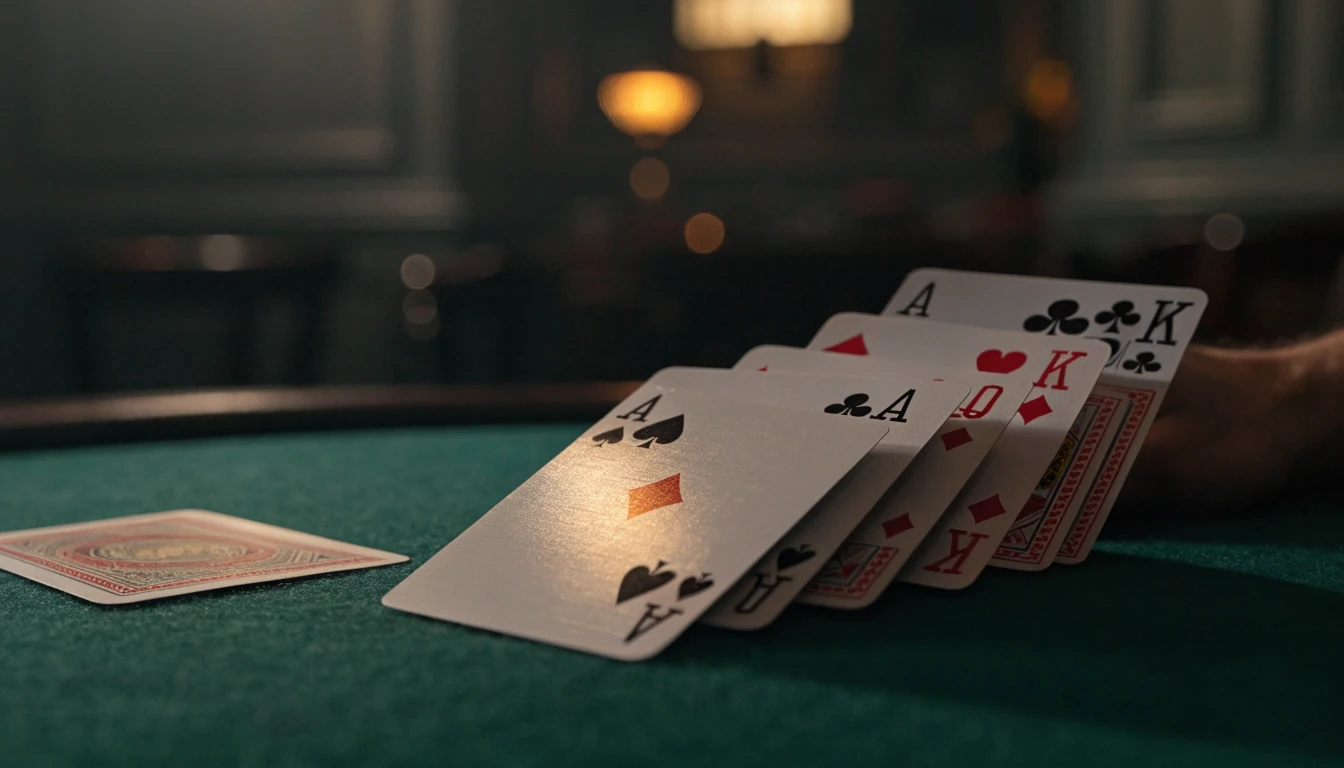
A live Hi-Lo table has a physical-card sequence behind the result on screen. The important detail is the reference card: the winning card from one hand remains exposed and becomes the card against which the next round is judged. So the next hand does not simply begin with a fresh, unrelated reference. The previous result carries forward.
That can take a moment to get used to if you have played a version where each turn feels separate. I find it helps to watch the exposed card before looking at anything else. It tells you which card is serving as the reference, while the new reveal supplies the next result. The display may make the game feel like a string of quick predictions; the physical sequence is what links one hand to the next.
Before the next winning card is revealed, three cards are burned. In other words, those cards are taken out of the sequence leading to the result rather than being presented as the winning card for that hand. The detail matters because there is activity between the reference card and the card that settles the round. You may see the reveal as one simple event, but the described procedure includes those burned cards first.
If you’re looking at hi-lo casinos in the UK for 2026, payout timing is one practical detail to check. Use this list as a starting point and review each operator’s terms before you choose.
Payout speed: 1-3 business days Revery Play lists a payout speed of 1–3 business days, giving you a stated timeframe to consider.
Payout speed: 1-3 business days Chanze lists a payout speed of 1–3 business days, a useful detail for your comparison.
Payout speed: 1-3 business days Dieselwin lists a payout speed of 1–3 business days, so you have a stated estimate for payouts.
Payout speed: 1-3 business days NightWin lists a payout speed of 1–3 business days, which gives you a clear timing detail to check.
Payout speed: 1-3 business days EvoSpin lists a payout speed of 1–3 business days, offering you a stated timeframe to bear in mind.
Payout speed: 1-3 business days Britsino lists a payout speed of 1–3 business days, giving you one concrete detail to review.
Payout speed: 1-3 business days SlotoSport lists a payout speed of 1–3 business days, so you can take its stated payout timing into account.
Payout speed: 1-3 business days x3bet lists a payout speed of 1–3 business days, a stated estimate for you to consider.
Payout speed: 1-3 business days Jetsetspins lists a payout speed of 1–3 business days, giving you a specific timeframe to check.
Payout speed: 1-3 business days NightLuck lists a payout speed of 1–3 business days, providing you with a stated payout estimate.
A specialist review describes a setup using six decks of 48 cards, with tens removed. That is a description of the setup in that review, not a reliable description of every live Hi-Lo table. The useful point for following the sequence is that cards are dealt from a shoe and the previous hand’s winning card remains visible as the next reference.
The shoe is connected to a continuous shuffler. Cards from the previous round are returned to it immediately, rather than being kept aside until a long sequence of hands has finished. That changes how the shoe should be understood: it is not simply a pile of cards steadily shrinking as rounds pass. The winning card stays exposed for its role as the reference, while cards from the previous round go back into the shuffler.
Those two details can seem contradictory at first: how can the previous winning card be a reference if cards from the prior round are returned to the shuffler? The key is to separate what the table presents from what the shuffler does. The exposed card is used to define the next comparison; the cards are also returned to the continuous shuffler as part of the dealing process. The reference role does not mean the shoe is being treated as a single shrinking deck.
When you watch a live round, keep the sequence in view:
- The previous hand’s winning card is exposed as the reference.
- Three cards are burned before the next winning card appears.
- The new winning card becomes the exposed reference for the following round.
- Cards from the previous round are returned to the continuous shuffler.
That is the physical rhythm to follow. It is more useful than trying to infer the shoe’s composition from a short stretch of play. A run of visible cards does not, by itself, tell you how many decks the particular table uses, especially when the cards are being returned to a continuous shuffler.
I used to assume that a card left on display meant it had simply been removed from the shoe for good. Here, its job as the reference card and the handling of cards by the shuffler are separate parts of the procedure. The exposed card is there so the next round has a clear starting point; it does not establish that the whole shoe is being depleted in the same way as a game where used cards stay out.
There is no need to make the sequence more mysterious than it is. Watch which card remains exposed, note that three cards are burned before the next winning reveal, and remember that the previous round’s cards return to the continuous shuffler. That gives you a clear picture of the live shoe’s movement without assuming that every table uses an identical deck arrangement. The mechanics, not the table’s visual pace, are what matter.
Live Shoe Rhythm
- The winning card from the previous hand serves as the next reference.
- Three cards are burned before the new winning card is revealed.
- Cards from the prior round are returned to a continuous shuffler.
- The physical sequence links hands, regardless of the visual pace.
Choosing an Online Hi-Lo Game Without Chasing a “Best” Label
I used to treat “best” as if it were a useful measurement. It isn’t, unless you know what is being measured. A game can look attractive because its screen is polished or its choices are presented neatly, while the part that affects a decision sits in the pay table. That is where I’d start when comparing online Hi-Lo games: not with a ranking, but with what each available bet pays.
For a Higher or Lower choice, the recommended approach is to select the side with the larger payout. That sounds almost too simple, but it gives you something concrete to check. Look at the options offered and compare their stated returns rather than assuming that a familiar-looking choice is automatically the sensible one. If the table makes one direction pay more than the other, that difference matters to your choice.
It does not mean you can turn the payout into a promise of profit. A return figure describes the game’s theoretical result across play, not what will happen in your session. I have made the mistake of seeing a tidy percentage and treating it like a forecast. It isn’t one. You can make a choice that follows the recommended approach and still lose; a pay table does not remove uncertainty.
A specialist review reports the game’s highest return as 96.23% when betting higher than 4 or lower than 10. That is a specific reported result, not a figure I’d apply to every Hi-Lo game or every version of it. The distinction matters: the return is attached to those betting choices in the described game. If the game in front of you has a different pay table or presents different options, that reported percentage does not tell you its return.

I’d also resist comparing two games by lifting one attractive number from each page. First check what the number refers to: a particular bet, a particular set of choices, or the game as a whole. Then see whether the pay table on the game itself supports the comparison. If the information is unclear, there is no honest way to fill in the blanks by guessing. A headline percentage with no clear connection to the available bets is not much help.
The same applies to labels such as “best Hi-Lo casino” or “top game”. They often collapse several different things into one word. You might care about the pay table; someone else might be looking for a particular format. A ranking cannot settle that for both of you, and a casino name alone tells you nothing about how the Hi-Lo bets are priced. I would rather compare the game’s own choices than trust a badge that does not explain its basis.
A practical comparison can stay small. Open the pay table, identify the Higher and Lower bets, and compare what each pays. If the game gives you more than one way to place those bets, treat each option separately rather than assuming the same return applies throughout. The recommendation is to choose the option with the higher payout, but that is a way of comparing the choices—not a guarantee that one session will go well.
Then keep the scope of any return claim in view. The 96.23% figure belongs to the stated Higher-than-4 or Lower-than-10 choices in the game described by a specialist review. It is not a universal Hi-Lo benchmark. I would not use it to rank every site, and I would not assume that a game with a different table matches it. Small detail. Big difference.
- Compare the stated returns in the pay table.
- Select the side with the larger payout.
- Treat reported returns as specific to the described bets.
- Trust “best” labels without knowing the measurement.
- Assume a high percentage is a forecast of profit.
- Use a single figure to rank different casino sites.
There is no need to turn this into a hunt for a perfect label. The useful question is narrower: can you see what the available bets pay, and does the comparison actually relate to the choice you are considering? If yes, you have a basis for choosing between those options. If not, calling the game “best” does not make the missing detail appear.
I have found that the word “best” can make me stop checking just when I should be paying attention. A pay table is less exciting, but it gives you something you can inspect. Compare the stated payouts, treat reported returns as specific to the bets they describe, and don’t mistake a theoretical figure for a personal outcome. Less sparkle. More useful.
Live Hi-Lo Online: A Reel-Based Version
“Live” can be a slippery label when you are looking for Hi-Lo. The familiar card-table version is built around exposed cards. A reel-based version works differently: rather than watching a dealer reveal a card from a shoe, you make a directional choice for a reel and see where it stops. The surface idea is still higher or lower, but the object being judged has changed.
A specialist review describes one such format in which the player chooses Higher or Lower on a single reel. If the reel stops on a number in the selected direction, the bet wins. A stop in the opposite direction loses, and landing on a tie loses as well. That is a specific description, not a rule I’d assume applies to every game carrying a Hi-Lo label. Check the rules for the version in front of you; names can make different mechanics sound more alike than they are.

That distinction matters if you arrived expecting a live card shoe. In the reel format described here, the decision is settled by the reel’s stopping number, not by comparing a newly exposed card with a reference card. There is no reason to import assumptions from the shoe game just because both use the language of higher and lower. Different mechanism, different settlement.
The same specialist account describes a choice after a win: carry the original bet and its winnings into another play, or collect and begin again. Carrying the amount forward is often called a parlay. In plain terms, you are letting the successful result become part of the next stake instead of taking it off the table. Collecting is the other path: end that run and keep the winnings already secured.
I can see why the parlay option feels tempting. A win is sitting there, and the interface may make continuing look like the natural next click. But the next outcome is still uncertain; a previous win does not make the next reel more likely to land in your chosen direction. If you continue and lose, the game’s stated rule is that a wrong guess voids all winnings collected in that game. That makes “I’ll just keep going with the win” a decision with a real downside, not a free extra turn.
Collecting is less dramatic. It also gives you a clear stopping point. I’ve learned not to treat a displayed win as money I should automatically put back into play. The choice is not a test of nerve or a secret strategy; it is whether you want to risk the run’s accumulated winnings for another result. No clever trick there.
Parlay Risk
A wrong guess in a parlay voids all winnings collected during that game.
Before placing a bet, look for the rules explaining what counts as Higher, Lower and a tie on that particular reel. Then confirm what happens after a win and what the game says about a losing guess. If the explanation only describes the direction of the bet but not the settlement, pause rather than filling in the gaps from a card-based game you have played elsewhere.
This is why a reel-based Hi-Lo game can appear in the same broad category as live card games while feeling quite different in practice. The directional choice is shared, but the reel supplies the outcome, and the available post-win choice shapes how a run continues. “Live” alone tells you little. Read the mechanics first.
The Basic Hi-Lo Choice: Higher or Lower?
Hi-Lo strips a card game down to one question: will the next card be higher or lower than the one you can see now? You are not trying to name the exact card. You are judging its direction relative to the current card.
That sounds almost too simple. I remember treating simple as the same thing as easy, which is how I ended up making quick guesses without thinking through what the comparison actually meant. The choice is narrow, but it still asks you to weigh two possible outcomes while accepting that you cannot know what comes next.
“Higher” and “lower” are relative terms here. The next card does not have to be high or low in some general sense; it has to rank above or below the current one under that game’s rules. A card that feels middling can still be higher than one just beneath it, or lower than one just above it. That is the whole comparison.

Some versions also let you bet that the next card will have the same value. That changes the available prediction, but it does not change the basic idea: your choice is about how the next card compares with the one already showing. Before making a guess, it is worth noticing which options the particular game actually offers rather than assuming every Hi-Lo table works identically.
The visible card can make one direction feel obvious. I have learned not to confuse “obvious” with certain. A guess is still a guess, even when one side looks more plausible than the other. The game asks for a decision, not a guarantee—and a confident feeling does not tell you what the next card will be.
This is also why the name can cover experiences that look different on screen. The central idea remains a higher-or-lower prediction, while the presentation and available choices can vary between versions. If you have arrived at a Hi-Lo casino game expecting a complicated set of rules, the core decision is refreshingly plain. If you have arrived expecting plain to mean predictable, that is a different story.
I find it helps to keep the question small. Look at the card in front of you, then think only about whether the next one will rank above or below it. It is easy to start inventing a story about what must come next. The game does not owe you a pattern, and a previous guess does not make the next one certain.
In some versions of Hi-Lo, you can bet that the next card will have the same value as the current one.
That distinction matters in an online Hi-Lo game, where the screen can make each choice feel like a neat little puzzle. It is a comparison, not a promise of control. You can understand the rule perfectly and still be wrong; understanding what you are being asked to predict is not the same as knowing the result.
So when I see “simple” attached to Hi-Lo, I read it narrowly: simple to understand, not certain to win. The basic choice is just higher or lower than the current card, with a same-value option in some versions. Nothing more mysterious than that. Plenty uncertain, though.
Draw Hi-Lo Online: A Deck That Changes as You Play
Draw Hi-Lo is different from a game that keeps feeding cards back into a shoe. It uses one standard deck of 52 cards, and a card that has already appeared stays out for the rest of that game. Aces count as low. That shrinking supply is the detail that changes the strategy.
In a fresh deck, you have no history to work from: you do not know which ranks will show up next. As cards are exposed, though, you can keep track of what is gone. If several low cards have appeared, the remaining deck contains a greater share of higher cards than it did at the start. If high cards have been removed, the balance shifts the other way. It does not tell you what the next card will be. It changes the odds you are judging.
I used to treat every guess as if the deck had reset between decisions. That is an easy mistake when the screen keeps the play moving. But in Draw Hi-Lo, previous cards matter. You are not just looking at the current card and making the same call from scratch; you are also working with a deck whose composition has changed.

That is why two strategy figures reported in a specialist review need to be read as different approaches to this specific format. The review gives a return of 96.07% for basic strategy and 100.36% for a card-counting strategy. Those are reported theoretical returns, not a promise about what will happen in a session or a figure that automatically applies to every version labelled Hi-Lo.
Basic strategy gives you a fixed decision approach. Card counting adds another layer: keeping a running picture of the ranks that have left the deck and using that information when assessing the remaining possibilities. A return above 100% can look like a green light. It is not. The figure belongs to the calculation reported by that review; it does not mean an individual player will come out ahead, and it should not be treated as a guaranteed result.
There is also a practical difference between knowing that counting can change the calculation and actually doing it consistently. You need to remember which cards have appeared, avoid losing track as decisions stack up, and understand how the game’s pay table treats each choice. If you are playing casually, a fixed strategy may be easier to follow. If you want to explore counting, slow down and learn the method rather than assuming that a vague sense of “more high cards left” is enough.
A single deck makes that information relevant, but it does not make the game predictable. Every exposed card narrows what remains; it never removes uncertainty. I find that a useful distinction. “Skill-based” can sound like control, when what you really have is a better-informed estimate.
Draw Hi-Lo Setup
- Confirm the game is specifically Draw Hi-Lo.
- Verify that cards stay out of the deck after appearing.
- Check the pay table for how choices are priced.
- Determine if you will use a basic or card-counting strategy.
Before playing, check that the game you have opened is Draw Hi-Lo and that its rules match the format you intend to play. The name alone does not tell you whether cards stay out, how the choices are priced, or how the return figures were calculated. One deck, no reset. That’s the point.
Checking a UK Hi-Lo Casino Site Before You Deposit
When I’m looking at a Hi-Lo site, I treat the licence check as a separate job from deciding whether I like the game. A polished page or familiar card layout tells you nothing about who is legally responsible for running it. For real-money online gambling in Great Britain, the operator needs the relevant licence from the UK Gambling Commission (UKGC).
The Commission oversees commercial gambling in Great Britain and is the sole regulator for that activity. Its remit includes remote gambling offered to consumers there, even when the operator’s key equipment is located elsewhere. So a company cannot avoid the requirement simply by hosting its systems abroad. The Gambling Act 2005 is the main law for England, Wales and Scotland; it does not cover Northern Ireland.

I used to treat a licence badge in a website footer as the whole check. It isn’t. Open the UKGC public register and look for the business named as the operator, then compare the details with the site you intend to use. Check the licence number there before depositing, rather than relying on a logo or a claim on the casino’s own page. A licence belongs to a particular business; seeing a regulator’s name mentioned somewhere does not establish that the site in front of you is covered.
There is a distinction worth keeping straight: the Commission grants operating licences to gambling businesses, while individuals who carry out regulated roles may hold personal licences. A casino’s general reference to “licensed staff” is not a substitute for checking the business’s operating status. If the company name or licence details do not line up with the register, pause instead of trying to explain away the mismatch.
For a Hi-Lo casino site serving Great Britain, the legal test is not whether the game looks like a real card table, or whether the operator is based in Britain. It is whether the business offering remote gambling to British consumers holds the appropriate UKGC licence. That is the point to verify before you put money into an account. The register, not the sales copy.

The UK is not a single licensing territory in every legal detail: the Gambling Act’s coverage is England, Wales and Scotland, while Northern Ireland has a different legal framework. That does not change the practical check for a site offering remote gambling to consumers in Great Britain: confirm the operator against the Commission’s register. I’ve learned not to let a convincing interface do that checking for me. A minute spent on the register is less exciting than a new game, but it answers the question that matters first: who is authorised to offer it?
Card Values and Pots in Online Hi-Lo
The card values are what turn a simple-looking prediction into a running balance. In the online Hi-Lo game described here, an ace counts as one point and a king as thirteen, with the other cards placed between them in rank order. You compare the next revealed card with the current one, then choose whether to call it higher or lower.
Pot
The accumulated total of money built up through successful calls in a game, which is voided if a guess is incorrect.
That value scale matters because the pot is not just a record of how many guesses you have made. It tracks the money built up through successful calls. When a guess is right, the winnings are added to the pot. The amount added depends on the game’s payout rules; the card value tells you which direction counts as correct, not by itself how much the pot grows.
I used to look at a growing pot and mentally mark it as money already secured. That is a bad habit. It is still part of the game, not a separate balance you can assume is yours to keep. If you guess incorrectly, the money placed on that decision is lost, and the winnings collected during that game are voided too. One miss can wipe out the progress you were treating as safely banked.
So it helps to keep three things distinct: the value of the card on screen, the money placed on the current call, and the accumulated pot. The card gives you the comparison point. Your call puts money at risk. A correct result adds winnings to the pot; a wrong one ends that run without those accumulated winnings. The display may make the total feel tangible, but it remains conditional on what happens next.
This is why I would not judge a hi-lo casino game by the size of a pot shown during play alone. A large running total does not tell you what you will actually leave with after the next decision. Read the game’s own payout display and keep track of whether a figure represents a current stake or winnings accumulated so far. They are not interchangeable.

The values are plain. The pot is less so.
When a Tie Changes the Hi-Lo Bet
A tie can look like a harmless middle result: the next card has neither beaten the current one nor fallen below it. In the Hi-Lo card game covered here, that reading is costly. If the next card has the same value as the reference card, a Higher or Lower bet loses.
That rule is easy to miss when you are focused on the two obvious directions. You might think, “It wasn’t higher, but it wasn’t lower either, so perhaps my stake comes back.” Not in this version. A matching value is a losing outcome, not a refund or a neutral pause.
The distinction matters because a prediction has three possible results, even when the betting choices show only two. The next card can be higher, lower, or equal in value. Choosing Higher wins only when the card is higher; choosing Lower wins only when it is lower. A tie fits neither winning condition.
I’ve found that this is the sort of small rule that can change how a game feels once you have money in it. A losing guess is disappointing enough; discovering that a tie counts against you after you assumed otherwise is worse. Read the outcome rules before placing a bet, rather than relying on the labels alone.
Tie Outcome
In this version of Hi-Lo, if the next card has the same value as the reference card, both Higher and Lower bets lose.
There is another consequence to keep in mind: a wrong guess voids all winnings collected in that game. So if a tie is treated as a loss, it can end the run and take those accumulated winnings with it. Don’t count a tied card as a safe result unless the rules for the particular game explicitly say so.
One caveat: Hi-Lo formats do not all settle ties in the same way. This rule applies to the card game described here, where Higher and Lower both lose on a matching value. A different format may define the outcome differently, so check its displayed rules rather than carrying assumptions from another game across.
Small rule. Real cost.
A Hi-Lo Casino Site with a Single, Shrinking Deck
A single-deck Hi-Lo game has a simple constraint: once a card has been used, it is not put back. The deck therefore gets smaller as the game progresses, and that card cannot turn up again in the same game. That changes what “higher” or “lower” means in practice: the next draw comes from the cards still available, not from a fresh, complete deck.

I find that detail easy to overlook when the screen makes each decision feel like a separate little round. It isn’t separate in that way. The game’s history matters because the used cards are gone. You are dealing with a changing pool, not a reset after every reveal.
There is, however, a conflict in descriptions of the format. One account describes a single deck of 52 cards, with used cards kept out; another describes six 48-card decks and continuous shuffling. Those are different mechanics, not two ways of saying the same thing. A continuously shuffled shoe can return cards to play, while a shrinking single deck cannot. So don’t assume that every Hi-Lo game found on a casino site follows the single-deck version.
Before you play, look for the game’s own rules and check whether they say that cards are removed after use or returned to a shuffler. That small line tells you whether a card you have already seen is still possible. If the rules describe a single shrinking deck, keep that in mind throughout the game rather than treating each new card as an isolated event.

It also puts the game’s risk in plain view: a wrong guess loses the placed money and voids winnings already collected in that game. Knowing the deck format does not make a prediction certain. It just tells you what is still in play.
Small difference. Big consequence.
How to Play a Round of Hi-Lo
Start with the card the game deals at random. That is your reference point: your first decision is whether the next card will rank higher or lower. If the direction feels obvious, choose it; if it does not, you still have to pick a side or stop, depending on the options the game provides.
Before you commit, look at the pay table. A correct prediction pays according to its listed terms, so the choice is not only about which card seems more likely. I’ve learned not to tap through that part on autopilot. A plausible guess and a worthwhile bet are not always the same thing.

Once you choose, the next card settles the call. If it goes in your chosen direction, the game awards the payment shown in the pay table. A tie may be treated as a push in this version, while a wrong prediction loses the bet. More importantly, a wrong guess voids all winnings collected during that game, so a growing total is not money safely banked.
After a correct call, check what the game lets you do next. If it offers a choice to continue or collect, continuing puts the accumulated amount at risk again; collecting ends the round with what the game pays out. I prefer to decide my stopping point before a run gets tempting, rather than letting one win make the next decision for me.
That is the round in practice: take the random starting card, make a directional call, read the result, then choose whether to carry on or cash out. No magic to it.
Prepared by the Betninja editorial staff.